Topzle Topzle

Concordat of Worms

Updated: Wikipedia source

Concordat of Worms

The Concordat of Worms (Latin: Concordatum Wormatiense; German: Wormser Konkordat), also referred to as the Pactum Callixtinum or Pactum Calixtinum, was an agreement between the Catholic Church and the Holy Roman Empire which regulated the procedure for the appointment of bishops and abbots in the Empire. Signed on 23 September 1122 in the German city of Worms by Pope Callixtus II and Emperor Henry V, the agreement set an end to the Investiture Controversy, a conflict between state and church over the right to appoint religious office holders that had begun in the middle of the 11th century. By signing the concordat, Henry renounced his right to invest bishops and abbots with ring and crosier, and opened ecclesiastical appointments in his realm to canonical elections. Callixtus, in turn, agreed to the presence of the emperor or his officials at the elections and granted the emperor the right to intervene in the case of disputed outcomes. The emperor was also allowed to perform a separate ceremony in which he would invest bishops and abbots with a sceptre, representing the lands that constituted the temporalities associated with their episcopal see.

Tables

· Concordat › Agreements
I, Calixtus, bishop, servant of the servants of God, do grant to thee, beloved son, Henry—by the grace of God emperor of the Romans, Augustus—that the elections of bishops and abbots of the German kingdom, who belong to that kingdom, shall take place in thy presence, without simony or any violence; so that if any dispute shall arise between the parties concerned, thou, with the counsel or judgment of the metropolitan and the coprovincial bishops, shalt give consent and aid to the party which has the more right. The one elected shall receive the regalia from thee by the scepter and shall perform his lawful duties to thee on that account. But he who is consecrated in the other parts of thy empire [i.e., Burgundy and Italy] shall, within six months, and without any exaction, receive the regalia from thee by the scepter, and shall perform his lawful duties to thee on that account (saving all rights which are known to belong to the Roman Church). Concerning matters in which thou shalt make complaint to me, and ask aid—I, according to the duty of my office, will furnish aid to thee. I give unto thee true peace, and to all who are or have been of thy party in this conflict.
Agreement of Calixtus II
I, Calixtus, bishop, servant of the servants of God, do grant to thee, beloved son, Henry—by the grace of God emperor of the Romans, Augustus—that the elections of bishops and abbots of the German kingdom, who belong to that kingdom, shall take place in thy presence, without simony or any violence; so that if any dispute shall arise between the parties concerned, thou, with the counsel or judgment of the metropolitan and the coprovincial bishops, shalt give consent and aid to the party which has the more right. The one elected shall receive the regalia from thee by the scepter and shall perform his lawful duties to thee on that account. But he who is consecrated in the other parts of thy empire [i.e., Burgundy and Italy] shall, within six months, and without any exaction, receive the regalia from thee by the scepter, and shall perform his lawful duties to thee on that account (saving all rights which are known to belong to the Roman Church). Concerning matters in which thou shalt make complaint to me, and ask aid—I, according to the duty of my office, will furnish aid to thee. I give unto thee true peace, and to all who are or have been of thy party in this conflict.
Edict of Henry V
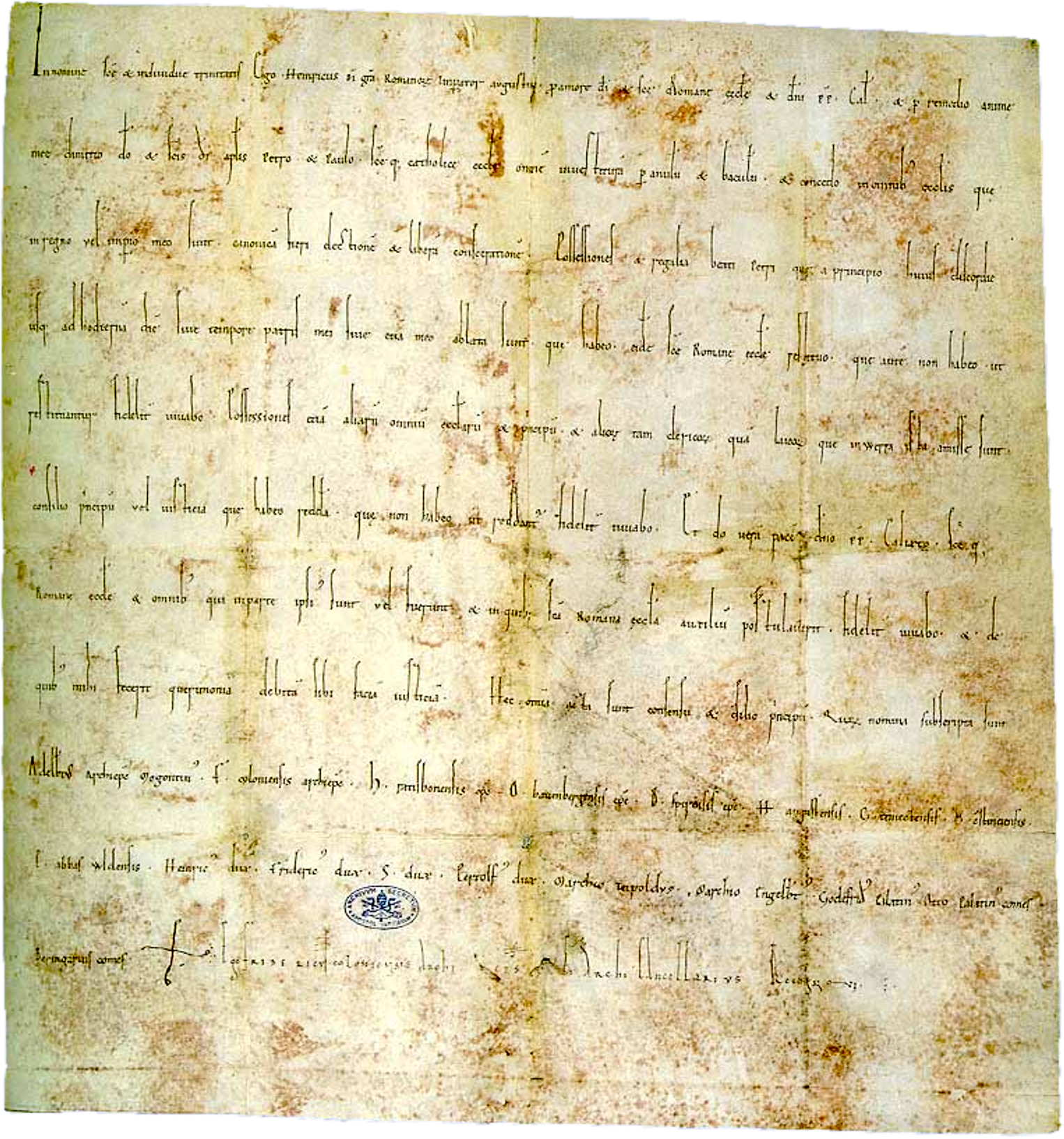
In the name of the holy and indivisible Trinity I, Henry, by the grace of God emperor of the Romans, Augustus, for the love of God and of the Holy Roman Church and of our lord Pope Calixtus, and for the salvation of my soul, do surrender to God, and to the holy apostles of God, Peter and Paul, and to the Holy Catholic Church, all investiture through ring and staff; and do grant that in all the churches that are in my kingdom or empire there may be canonical election and free consecration. All the possessions and regalia of St. Peter which, from the beginning of this discord unto this day, whether in the time of my father or in mine have been seized, and which I hold, I restore to that same Holy Roman Church. And I will faithfully aid in the restoration of those things which I do not hold. The possessions also of all other churches and princes, and of all other persons lay and clerical which have been lost in that war: according to the counsel of the princes, or according to justice, I will restore, as far as I hold them; and I will faithfully aid in the restoration of those things which I do not hold. And I grant true peace to our lord Pope Calixtus, and to the Holy Roman Church, and to all those who are or have been on its side. And in matters where the Holy Roman Church shall ask aid I will grant it; and in matters concerning which it shall make complaint to me I will duly grant to it justice. All these things have been done by the consent and counsel of the princes. Whose names are here adjoined: Adalbert archbishop of Mainz; F. archbishop of Cologne; H. bishop of Ratisbon; O. bishop of Bamberg; B. bishop of Spires; H. of Augsburg; G. of Utrecht; Ou. of Constance; E. abbot of Fulda; Henry, duke; Frederick, duke; S. duke; Pertolf, duke; Margrave Teipold; Margrave Engelbert; Godfrey, count Palatine; Otto, count Palatine; Berengar, count. I, Frederick, archbishop of Cologne and arch-chancellor, have ratified this.
Agreement of Calixtus II
Edict of Henry V
I, Calixtus, bishop, servant of the servants of God, do grant to thee, beloved son, Henry—by the grace of God emperor of the Romans, Augustus—that the elections of bishops and abbots of the German kingdom, who belong to that kingdom, shall take place in thy presence, without simony or any violence; so that if any dispute shall arise between the parties concerned, thou, with the counsel or judgment of the metropolitan and the coprovincial bishops, shalt give consent and aid to the party which has the more right. The one elected shall receive the regalia from thee by the scepter and shall perform his lawful duties to thee on that account. But he who is consecrated in the other parts of thy empire [i.e., Burgundy and Italy] shall, within six months, and without any exaction, receive the regalia from thee by the scepter, and shall perform his lawful duties to thee on that account (saving all rights which are known to belong to the Roman Church). Concerning matters in which thou shalt make complaint to me, and ask aid—I, according to the duty of my office, will furnish aid to thee. I give unto thee true peace, and to all who are or have been of thy party in this conflict.
In the name of the holy and indivisible Trinity I, Henry, by the grace of God emperor of the Romans, Augustus, for the love of God and of the Holy Roman Church and of our lord Pope Calixtus, and for the salvation of my soul, do surrender to God, and to the holy apostles of God, Peter and Paul, and to the Holy Catholic Church, all investiture through ring and staff; and do grant that in all the churches that are in my kingdom or empire there may be canonical election and free consecration. All the possessions and regalia of St. Peter which, from the beginning of this discord unto this day, whether in the time of my father or in mine have been seized, and which I hold, I restore to that same Holy Roman Church. And I will faithfully aid in the restoration of those things which I do not hold. The possessions also of all other churches and princes, and of all other persons lay and clerical which have been lost in that war: according to the counsel of the princes, or according to justice, I will restore, as far as I hold them; and I will faithfully aid in the restoration of those things which I do not hold. And I grant true peace to our lord Pope Calixtus, and to the Holy Roman Church, and to all those who are or have been on its side. And in matters where the Holy Roman Church shall ask aid I will grant it; and in matters concerning which it shall make complaint to me I will duly grant to it justice. All these things have been done by the consent and counsel of the princes. Whose names are here adjoined: Adalbert archbishop of Mainz; F. archbishop of Cologne; H. bishop of Ratisbon; O. bishop of Bamberg; B. bishop of Spires; H. of Augsburg; G. of Utrecht; Ou. of Constance; E. abbot of Fulda; Henry, duke; Frederick, duke; S. duke; Pertolf, duke; Margrave Teipold; Margrave Engelbert; Godfrey, count Palatine; Otto, count Palatine; Berengar, count. I, Frederick, archbishop of Cologne and arch-chancellor, have ratified this.

References

  1. Colin Morris notes that, while Calixtus was related to the House of Salian, the Imperial royal family, he "belonged to a
  2. Imposed on Henry's recognising the antipope, Gregory VIII.
  3. Here Archbishop Anselm of Canterbury conceded that "The King granted and commanded that from that time and henceforth no
  4. The sceptre replaced the imperial ring and staff as symbols of the Emperor's authority. It had originally been proposed
  5. Reiterating the refrain of papal victory over schismatics, other imagery on the room's paintings included the antipopes
    https://en.wiktionary.org/wiki/scabellum
  6. Adalbert was concerned, not with the possibility that the bishop had been involved in the murder of a senior member of t
  7. Jordan 2003, pp. 85–87.
  8. Jordan 2003, pp. 90–91.
  9. Jordan 2003, p. 91.
  10. Jordan 2003, p. 86.
  11. Jordan 2003, p. 97.
  12. Jordan 2003, pp. 98–99.
  13. Blumenthal 1991, pp. 169–170.
  14. Blumenthal 1991, pp. 170–171.
  15. Blumenthal 1991, p. 171.
  16. Stroll 2004, p. 378.
  17. Morris 1989, p. 162.
  18. Morris 1989, pp. 162–163.
  19. Morris 1989, p. 163.
  20. Melve 2007, p. 633.
  21. Tellenbach 1993, p. 284.
  22. Stroll 2004, p. 357.
  23. Stroll 2004, p. 387.
  24. Blumenthal 1991, pp. 171–172.
  25. Stroll 2004, p. 359.
  26. Stroll 2004, pp. 357–358.
  27. Stroll 2004, p. 358.
  28. Morris 1989, p. 164.
  29. Stroll 2004, p. 384.
  30. Stroll 2004, p. 385.
  31. Robert 1979, pp. 5–6.
  32. Stroll 2004, p. 388.
  33. Fuhrmann 1986, p. 92.
  34. Benson 1968, p. 229.
  35. Stroll 2004, p. 389.
  36. Robinson 1990, p. 437.
  37. Benson 1968, p. 228.
  38. Stroll 2004, p. 390.
  39. Blumenthal 1991, p. 173.
  40. Stroll 2004, p. 393.
  41. Stroll 2004, p. 391.
  42. Stroll 2004, p. 392.
  43. Cantor 1958, p. 202.
  44. Benson 1968, p. 231.
  45. Tellenbach 1993, pp. 284–285.
  46. Tellenbach 1993, p. 285.
  47. Cantor 1958, p. 214.
  48. Fuhrmann 1986, p. 93.
  49. Benson 1968, p. 305.
  50. Stroll 2004, p. 258.
  51. Cantor 1958, p. 269.
  52. Benson 1968, p. 230.
  53. Stroll 2004, pp. 393–394.
  54. Benson 1968, p. 232 + n.15.
  55. Morrison 1969, p. 269.
  56. Robinson 2004, p. 370.
  57. Benson 1968, p. 303.
  58. Bettenson 1973, pp. 111–112.
  59. Ehler & Morrall 1967, pp. 48–49.
  60. Stroll 1991, p. 138.
  61. Hoffmann 1959, p. 434.
  62. Walter 1993, p. 119.
  63. Stroll 2004, pp. 396–397.
  64. Huffman 2000, p. 42.
  65. Anderson 2016, p. 282.
  66. Anderson 2016, p. 283.
  67. Fuhrmann 1986, p. 94.
  68. Benson 1968, pp. 305–306.
  69. Benson 1968, p. 232.
  70. Ehler & Morrall 1967, p. 48.
  71. Huffman 2000, pp. 41–42.
  72. McCarthy 2013, pp. 77–80.
  73. Robinson 2004, p. 369.
  74. Morrison 1969, p. 407.
  75. Stroll 2004, pp. 395–396.
  76. Stroll 2004, p. 395.
  77. Stroll 2004, p. 397.
  78. Stroll 2004, pp. 398–399.
  79. Fliche 1946, p. 388.
  80. Jordan 2003, p. 99.
  81. Morrison 1969, p. 343.
  82. Tellenbach 1993, p. 330.
  83. Hicks 1973, p. 6.
  84. O'Malley 2011, p. 117.
  85. Benson 1968, pp. 229–230.
  86. Benson 1968, p. 251.
  87. Mesquita 2002, p. 27.
Image
Source:
Tip: Wheel or +/− to zoom, drag to pan, Esc to close.